Self-Performed Labor and Your Schedule
When the general contractor's own crews do the work, the schedule depends on one fewer phone call.
October 14, 2026 · 4 min read
Ask five general contractors what self-performed labor means and you may get five answers. The plain version is this: the contractor's own employees, working with the contractor's own equipment, do part of the physical work instead of hiring a subcontractor to do it. The rest of the project can still be subcontracted. What matters to an owner is which scopes are in-house and what that does to the schedule.
What self-perform actually means
Every general contractor manages. Some also build. A firm that self-performs keeps crews on its own payroll and its own machines in its own yard, ready to be sent where the job needs them. Concrete, earthwork and rough carpentry are common candidates across the industry, because they sit at the front of the sequence and everything else waits on them.
Raineri lists self-performed labor as one of the eight practices in its process. On the civil side it describes well-maintained, company-owned equipment and trained, highly skilled in-house tradespeople. It also says it works with flexible but strategic trade partnerships, which is the honest shape of most real projects: some work in-house, some with specialists.
Why it matters for schedule
A subcontractor is a business with several customers. When your slab is ready for forms and the framing crew is finishing another site across town, you wait. Nobody did anything wrong. That is simply how shared labor works.
When the general contractor's own crew is the one waiting to start, the contractor controls the answer. It can resequence overnight, add hours to beat a weather window, or pull a crew forward from a task that is not critical. A decision that would otherwise take three phone calls and a change order becomes a morning conversation on the job site.
Self-performing is not magic. Weather, material lead times and inspections do not care who signs the crew's paychecks. But control over the first links in the chain tends to protect everything that follows.
A civil example: the Buckley Road Bridge
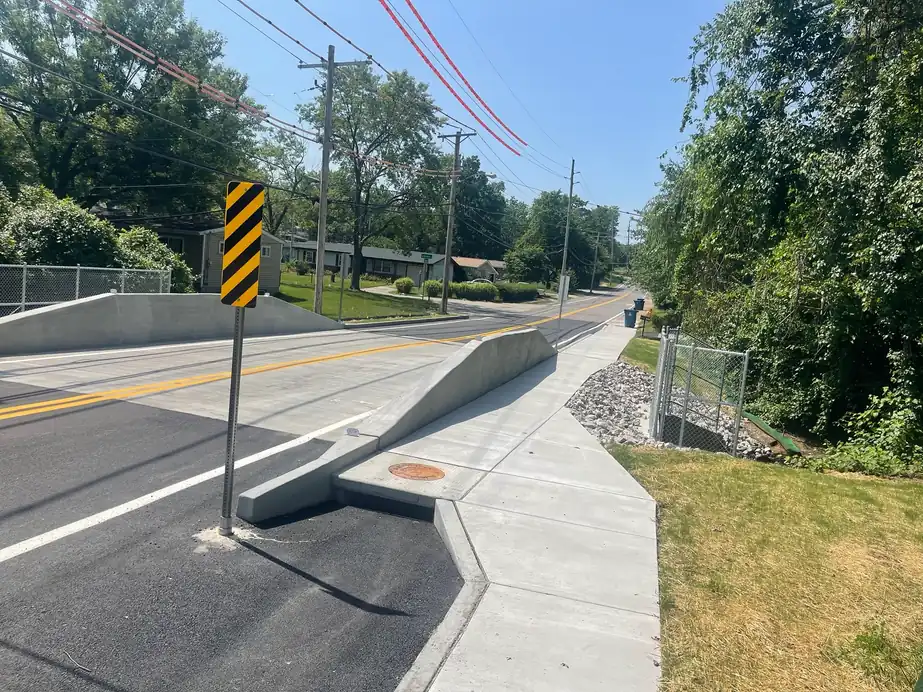
Raineri's Buckley Road Bridge project is a useful illustration. The client was St. Louis County, the engineer was Horner & Shifrin, and the work was completed in July 2025. Raineri describes it this way: its self-perform crews handled the replacement of both the vehicle and pedestrian bridges, located about half a mile south of Lemay Ferry Road.
Bridge work is a tightly ordered sequence. Demolition, foundations, structure, deck and approaches each depend on the step before. Every handoff between separate companies is a place where days can leak out. When one organization runs consecutive steps with its own people, those handoffs happen inside a single chain of command.
Questions to ask before you award
Do not accept "we self-perform" as an answer on its own. Ask what it means for your project:
- Which scopes will your own crews perform on this job, specifically?
- Who supervises those crews day to day, and are they dedicated to this project?
- Which equipment is company-owned and which will be rented?
- What happens to the schedule when a subcontractor falls behind?
- How are self-performed scopes shown in the bid, so I can see where the work sits?
A contractor that truly self-performs will answer these quickly and by name. One that does not will talk in generalities.
Where specialists still win
Self-performing everything would be a mistake. Elevators, fire alarm systems, curtain wall and specialty finishes are better handled by firms that do that one thing all year. A good general contractor picks its spots: it keeps in-house the work where schedule control is worth the most, and it brings in specialists where their depth is worth more than control.
That balance is the thing to evaluate. A contractor who self-performs nothing has little direct hand on your schedule. A contractor who insists on self-performing everything may be stretching its crews thin. The useful answer sits in between and should be specific to your project.
Fewer handoffs, clearer accountability
There is a second benefit that is easy to overlook. When the contractor's own crew builds something, there is one party to hold responsible for the quality and for the timing. Disputes about whose work caused a delay get shorter when fewer companies are in the chain.
Ask how self-performed work will be priced and tracked. Your contractor can show you how it appears in the budget and the schedule, and those documents will tell you more than any sales pitch.
If you have a building or civil project in the St. Louis area and want to understand which parts Raineri would build with its own crews, call the office at (314) 667-5913 or send a note through the contact page.
Raineri Construction, (314) 667-5913
Call (314) 667-5913More articles
What Preconstruction Settles Before Ground Breaks
The cheapest problems on any commercial project are the ones found while the work is still on paper.
Renovating an Old St. Louis Building: What to Plan For
Old brick buildings reward owners who investigate first and design second.